
Compressed Air Piping Systems: Material Selection Guide for Industrial Applications
If your air compressor is the heartbeat of your operation, your compressed air piping network is its veins and arteries. It carries that compressed air from the source to every point of use across your facility, and the material you choose has a direct impact on energy costs, air quality, maintenance needs, and how easily your system can adapt as your operation grows. Getting this choice right from the start can mean the difference between a system that runs efficiently for decades and one that quietly drains your budget through leaks, pressure drops, and corrosion.
Why Piping Material Matters So Much
Many facilities focus heavily on compressor selection and system design, then treat piping as an afterthought. But the pipe itself affects nearly every performance metric that matters: how much pressure is lost between the compressor and the tool, how clean the air stays, how often you’ll deal with leaks, and how much it costs to expand or reconfigure the system later. The three most common materials, black iron, copper, and aluminum, each bring very different strengths and weaknesses to the table.
Black Iron Pipe
Black iron has been the traditional choice for decades, largely because it’s inexpensive and widely available at almost any hardware supplier. However, its drawbacks tend to outweigh that initial cost advantage over time.
Black iron pipe is heavy, which makes handling, cutting, threading, and installation slow and labor-intensive, driving up installation costs even though the material itself is cheap. The threaded joints used to connect sections are a common source of leaks, and compressed air leaks are one of the most expensive hidden costs in any facility, since every leak represents compressor capacity and electricity being wasted around the clock.
Beyond leaks, black iron has a rough interior surface that creates friction and turbulence as air flows through it, increasing pressure drop. That rough surface also gives moisture, rust particles, and other contaminants somewhere to collect and build up over time. Because black iron is an iron-based material, it begins rusting from the inside almost immediately, even before installation in some cases, and that rust eventually makes its way downstream into your tools, valves, and finished products.
Copper Pipe
Copper is a step up in several respects. It’s relatively affordable, widely available, and has a smooth interior that supports good air quality with minimal contamination.
The main challenge with copper is installation. Joining copper pipe requires soldering or brazing with an open flame, which means a higher level of skill, more time per joint, and fire-safety precautions during installation. This also makes copper systems less flexible long-term: if your facility layout changes, machines get moved, or the plant expands, modifying a copper system means more cutting, more brazing, and more downtime than with quicker-to-install alternatives.
Copper is also vulnerable to thermal cycling, the repeated expansion and contraction that happens as temperatures fluctuate, which can stress joints over time. If the brazing work isn’t done to a high standard, those joints become likely points for slow leaks that are often hard to detect until energy bills start creeping up.
Aluminum Pipe
Aluminum tends to have the highest upfront material cost of the three, but it’s increasingly the preferred choice for modern compressed air systems, and for good reason.
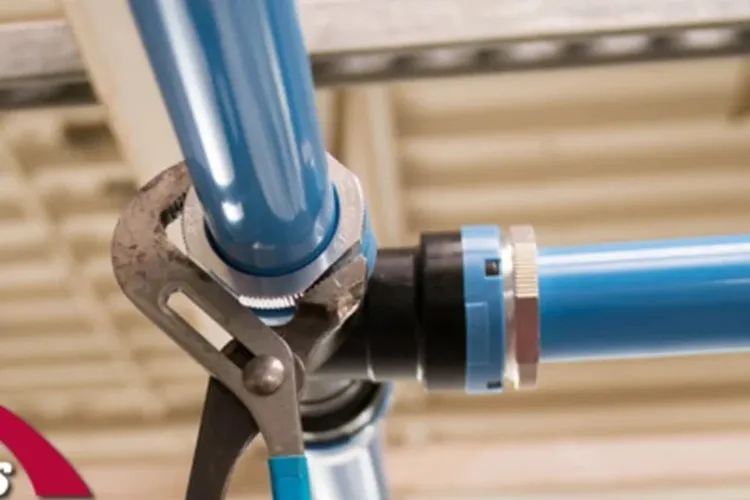
It’s extremely lightweight, which dramatically speeds up installation and reduces labor costs even with its higher per-meter price. Most aluminum systems use push-to-connect or quick-clamp fittings rather than threading, welding, or brazing, so installation doesn’t require an open flame and goes much faster.
The interior of aluminum pipe is smooth, similar to copper, which keeps line losses low and helps maintain consistent pressure throughout the system. Aluminum is also naturally corrosion-resistant, so there’s no risk of internal rust contaminating your air supply or degrading the pipe from within, which is a major factor in maintaining air quality for sensitive applications.
When you add it all up, faster installation, lower line losses, no corrosion-related maintenance, and a longer service life, aluminum typically delivers the lowest total cost of ownership over the life of the system, even though it costs more on day one. It’s also by far the easiest material to reconfigure. If your facility expands, adds equipment, or rearranges its floor plan, an aluminum system can usually be modified or extended in hours rather than days, with minimal disruption to production.
Making the Right Choice for Your Facility
The best material often depends on your facility’s size, growth plans, air quality requirements, and budget for upfront versus long-term costs. A facility that expects to stay static for many years and has tight upfront budget constraints might still consider copper or black iron, while a growing or quality-sensitive operation will usually find that aluminum pays for itself many times over.
At Airpro Technix, we provide complete design, installation, and commissioning of compressed air systems, helping you choose the right piping material and layout for your specific operation.
📞 +92 334 5933391
📧 info@airpro.com.pk